Cosy Fiction: Location, location, location
Establishing the characters is rather like a painter setting out the colours on their palette, too stretch the metaphor a little too far, some are cool, some are hot, and others mix well, but that is quite enough of that. My next stage in planning The Antiquarian was to establish the world in which everything happens. A detailed knowledge of the location is so important in making the story believable and relatable; there is also the aphorism ‘write what you know’.
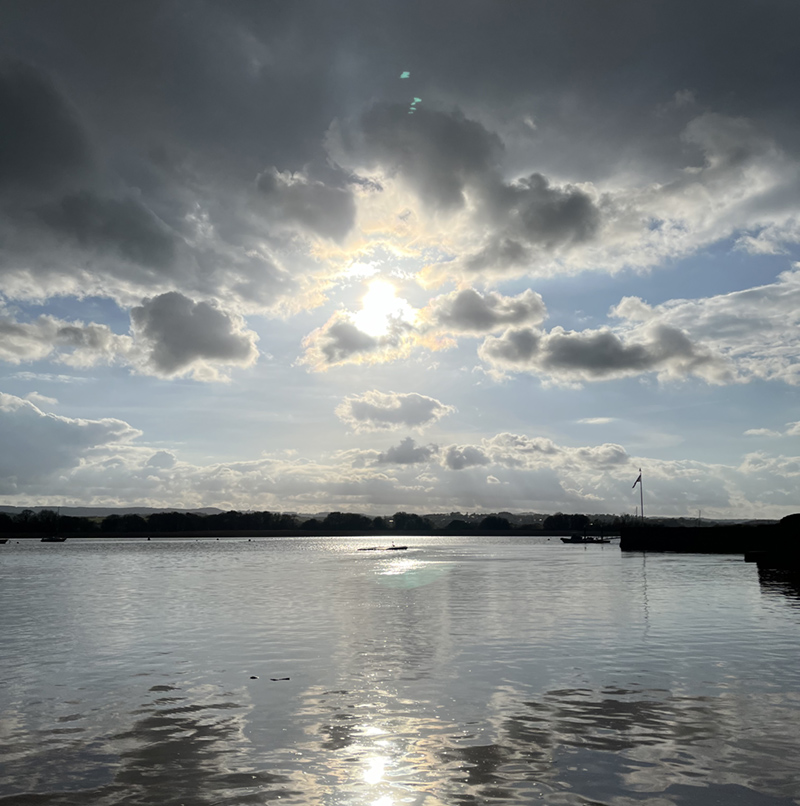
With this in mind, I set the Barton and Brooks series in Devon, where I first lived in the early ’80s when I was at art college here, living in central Exeter and then returning in 2019 to live in Topsham, an estuary town just outside Exeter on the banks of the River Exe.
These days, you can get a sense of what a place looks like from Google Maps, social media and search engines; however, these only give a sense of what a place looks like. To make the place live, I have to know what it feels like, to experience it, and that is a multi-sensory adventure. For me, the only way to do this is to go there, use all my senses and experience it for myself. I am lucky enough to live in Topsham so my research was right on my doorstep, the dog walks are all tried and tested, and the views and places are all real. I decided that Topsham would be the place where Whipton Barton would live, his place of sanctuary where he could get away from his day-to-day world of investigation. I suppose Barton’s sense of well-being about where he lives is reflected by my own experience of living here.
“Brought back lovely memories of our stay in Topsham.” Jill Dobson
In the 80s, I lived in Exeter, and it still has a completely different feel. It is not a large sprawling city like London; it is a classic English cathedral city, its mood dominated by its history and the looming presence of Cathedral at its heart. The siting of Edward Voss’s Antiquarian Bookshop in Cathedral Green felt an obvious place for such a shop. Having spent many hours there as a student doing photographic assignments and drawings, I knew it well and have always been amazed by the relative calm of the Green compared with the bustle of the main shopping street, literally a 2-minute walk away. Edward Voss’s walk home to Pennsylvania Road was one I did more or less every day for three years, and the feeling of the centre of Exeter changing between daytime and evening came back to me as I wrote the section with Edward’s walk.
In the next book in the series, The Publisher, there are some other venues, including London, where I was born, worked and lived for many years both before and after college. During the process of writing my first two books, I have discovered that for me, the curiosity needed to draw somewhere is closely related to the skills needed to write about a place, but writing allows you to use all your senses to convey a feeling about a place more than using sight alone.
So if you find future books set in far-flung locations, you will know my research budget has considerably improved and the series is going well!